Breaking News
Main Menu
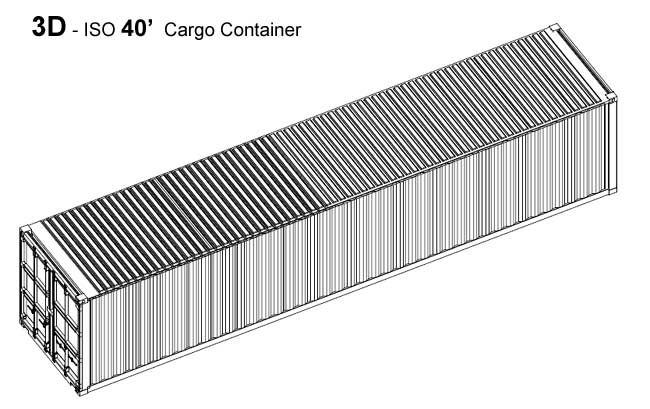
Autocad Drawing Iso Container Locks
среда 03 апреля admin 89
CAD/BIM Library of blocks 'ISO CONTAINER'. Free CAD and BIM blocks library - content for AutoCAD, AutoCAD LT, Revit, Inventor, Fusion 360 and other 2D and 3D CAD applications by Autodesk. CAD blocks and files can be downloaded in. Invalid file, drawing not valid, cannot open) can be solved by the Tip 2869. See also block-statistics. Container 20 feet in autocad 2004 3d format with details of each fold and locks, in a scale of 1:85 (1.46 MB) Container 20 feet in autocad 2004 3d format with details of each fold and locks, in a scale of 1:85.
Command entry:Create a container or select a local container. Rules rollout Choose Anything Unlocked. Track View Controller window Highlight and then right-click a track. Choose a command from the right-click menu. Using the Anything Unlocked with a you create gives you fine-grained control over which scene properties a user who inherits the container can edit. This topic explains the related concepts and commands. Pdf pearson guide verbal reasoning. The container-related commands available by right-clicking a highlighted track or tracks in the Track View Controller window are: • Lock • Unlock • Unlock Leaves • Hide • Conceal • Override All Locks These have different effects depending on the type of track they’re applied to, as described in the Interface section, following.
For the purposes of using these commands, there are four types of tracks: • NodeAn object in the scene. The node track serves as the parent of all of the object's animation tracks, such as transforms.
It is also the parent of any modifiers, materials, or animation layers applied to it. TipWhen you lock a node track with the Selected Objects filter on (the default status), the node no longer appears in the Track View hierarchy list. If this happens and you want to access the node’s tracks, click (Filter - Selected Objects Toggle) on the to make all nodes in the scene visible in the list.
• BranchAny parent track of controllers that could potentially be a leaf itself, based on the controller assigned. For example, the Position branch could have child Position X, Y, and Z leaves, or it could have a Point3 controller of its own, such as Bezier. A good way to recognize a branch track is to highlight and then right-click it and see if Assign Controller is available. • ComponentAn attribute of a node under the node that doesn't have a value itself, but serves to hold and organize leaf tracks that do have values.
Examples of component tracks include modifiers such as Bend, materials such as Standard, and maps such as Bitmap applied to the object. A component attribute is a special case, since locking it really just hides the user interface, so it displays as Hidden. You can show and hide the UI without unlocking with Expose and Conceal.
• LeafThe bottom-most tracks in the Track View hierarchy, with specific values in 3ds Max. An example of a leaf track is the Angle setting of the Bend modifier. Locks highlighted tracks, thus preventing any change in the property or properties the tracks control, or controllers for those tracks. For example, if you lock an object’s X Position track, you can then move it in the YZ plane, but not on the X axis. If a track is locked, the text “(Locked)” appears after its name in the track view hierarchy. Locking a parent track also locks all of its child tracks. For instance, if you lock an object’s Transform Rotation track, its X/Y/Z Rotation tracks are locked as well (assuming the default Euler XYZ rotation controller), thus preventing the object from being rotated at all.
Locking a component, such as a map or a modifier, hides the UI and locks all of its attributes. Unlocks highlighted locally locked tracks and any branch tracks that contain them. Unlocked attributes will not update in inherited containers. Unlocking a track unlocks any locked branch tracks above it in the hierarchy, all the way to the top of the hierarchy (that is, a node or component). For example, if you lock an object’s Transform (branch) track, and then unlock its X Position (leaf) track, this also unlocks the parent Position and Transform tracks.
However, it doesn’t lock other leaf tracks at the same level. However, unlocking a track does not unlock any hidden components. If you unlock tracks inside a hidden component, those tracks will be published to an Unlocked Tracks rollout, which replaces the hidden UI. Use this to limit the access that others have to parameters of your objects. Conversely, unlocking the parent in a locked hierarchy does not automatically unlock any locked children. For example, locking an object’s Position track also locks the X/Y/Z Position tracks (assuming the default Position XYZ controller).
But if you then unlock the same Position track, its children, the X/Y/Z Position tracks, remain locked. To unlock the dependent attributes of a selected track, use Unlock Leaves (see following). When locked attributes are inherited, they cannot be unlocked. Unlock Leaves. NoteIn the Track View hierarchy, all modifiers applied to an object are children of a Modified Object component track, which acts as a container for the modifiers. To see the UI for unlocked modifiers, the Modified Object attribute must be unlocked. As an example, in the following illustration, the upper part shows the Modified Object section of the hierarchy of an object to which the Bend modifier is applied.